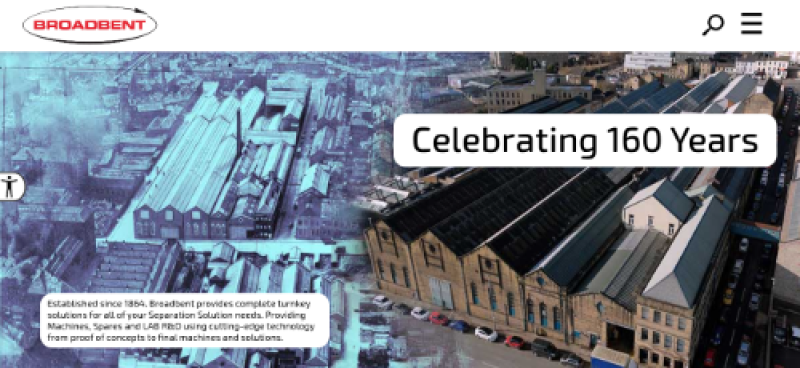
Bnode's largest project / client of 2025 was Thomas Broadbent's of Huddersfield, West Yorkshire.
Established in 1864, Broadbent provides Separation Solutions for a wide variety of industries, market sectors and end-use applications. They manufacture and supply industrial machinery, plus provide spares, servicing and LAB R&D. Broadbent are based in Huddersfield but they have locations across the globe - in Australia, Canada, China, India, Poland, South Africa, Thailand, and the USA too.
We worked with them from 2024 to 2025 to design, build and realise their new website and provide on-going website support and green hosting services too.
Back in 2024, their brief to us was:
1) To design and build a new website with multi-lingual capabilities and class-leading accessibility functionality,
2) To create an inclusive and usable website experience that reflects Broadbent's business morals and values,
3) To help with recruitment of younger generation workers, by giving them a sense of who Broadbent are as a company, what they stand for and aspire to,
4) Improve Broadbent's CSR (Corporate Social Responsibility) messaging, and
5) Substantially reduce Broadbent's digital carbon footprint and CO2 emissions.
This posed some challenges.
Because Broadbent is a huge multinational company with several divisions, working across many different industries and sectors, the website needed to showcase each division and the related products, solutions and services without becoming colossal and difficult to navigate.
On-page video playback for Broadbent's corporate videos needed to be incorporated too.
Not only was it the biggest project of 2025 but it’s also one of the most extensive websites that Bnode has worked on to date.
The solution we provided Broadbent with is:
- A comprehensive website with four language variants – English, French, German and Polish. So it’s multilingual as well as accessible.
- Video integration and on-site playback
- Reduced carbon footprint through low code and green hosting
- Accessibility tools for users with additional needs, following WCAG 2.2 where possible
- UX improvements
- SEO improvements and gains
- Better contact and enquiry routing and filtration, and
- A website that outperforms Broadbent's competitors, and, of course, is quicker and easier to update and keep up-to-date.
How were we able to do this whilst delivering substantial reductions in Broadbent's digital carbon and energy footprints?
Via a more efficient, leaner, lower code website with green hosting.
These are some of the stats.
Back in 2023, before Broadbent and Bnode started working together, the Broadbent website's homepage was a whopping 5MB with a carbon footprint of 3.924g in CO2 and equivalent emissions for every visit.
The old website was using 364KWH of energy and burning through the equivalent of 7 trees needed to offset it.
The new website now uses 48KWH of energy - that's 316KWH less. This means a big saving on hosting costs as well as an impressive reduction in carbon emissions associated with the website.
Now, the figures are a web page weight of 1.84MB and 0.584g of CO2 for the first visit - a reduction of 600%.
And, efficient web page caching and delivery means that on repeat visits to the homepage the figures are even lower - 0.019g of CO2 and a page weight size of 61.91 KB.
With a baseline of 10,000 visits to the website per month, and a split of 40-60 between new and returning visitors, the carbon footprint is 2.45kg per month.
That's the equivalent of driving 4.22 miles in a Tesla Model S, and watching 1 hour of Netflix (in HD).
Only one single tree would be needed to offset that CO2 in a year.
So, in summary and by way of comparison:
🔸Their old website was using 364KWH of energy and needed 7 trees to offset the emissions.
🔹Their new website now uses 48KWH of energy and needs one tree to offset the emissions.
🔸Someone visiting their old website produced 3.838g of CO2 or equivalent emissions.
🔹Someone visiting their new website produces 0.577g of CO2 or equivalent emissions.
An impressive reduction, as I'm sure you'll agree.
And here are just some of the benefits of a leaner website:
- Faster loading and reduced network delivery time to whatever device the website is being viewed on,
- Better user experience (UX) on all devices,
- Improved SEO and rankings for discoverability and citation, and
- Reduced development costs
All of which ultimately leads to higher engagement, more conversions, and simpler website maintenance and upkeep by focusing only on the essential features for your business or organisation.
Not only is the new website leaner, cleaner and greener, but it is more accessible too.
This is down to Bnode's built-in website accessibility and usability functionality, provided by our Accessibility Tool.
So, not only did Broadbent get a new and improved website that was easier to manage and update, but they gained big savings on digital energy consumption and carbon footprint too, as well as many other additional business benefits.
See Broadbent's website for yourself at
https://broadbent.co.uk/ and try out the in-built accessibility and multilingual functionality.
Lastly, if you're thinking about getting a new website in 2026 - big or small - and want to do digital 'right', then just reach out to Bnode ASAP as we're scheduling in Q1 and Q2 work right now.
You too can save your Yorkshire-based business or organisation money on hosting costs and get a feel-good factor from green hosting and reduced digital carbon footprint - whilst also gaining many other business benefits - just like Broadbent have done.
Request an introduction to find out more.
 Consultants Like Us