Have you watched 'Chris McCausland: Seeing into the Future' – an astonishing look at how tech is changing disabled people’s lives?
First shown on Sunday 23 November, at 8pm on BBC Two, and available on BBC iPlayer, the programme shows how, for disabled people, assistive technology from big tech firms has already brought about life-changing advancements.
Chris McCausland, who is blind, tries out some smart glasses at Meta - Meta Specs, which are always on and offer live video interpretation, telling you what you’re looking at.
Whatever you think of Meta ethically - and we appreciate that if you're not in direct need of such technology it's easy to preach about how unethical they are as a company - the documentary programme’s job is to highlight all of the possibilities that assistive technology brings.
As McCausland acknowledges, whilst it shouldn't have by rights, his phone actually became the most accessible tool he’s ever used. One of the ways he uses his phone is to "see" for him – his phone is, essentially, an eye with a mouth. “What T-shirt is this?” he asks, holding up a garment. “A grey T-shirt with a graphic logo of Deftones,” his phone obligingly replies. It can even tell him if the t-shirt needs ironing.
At MIT, a nanotechnologist tells McCausland how molecular devices could repair cells inside our bodies. He also tries bionic gait assistance – a device that straps on to the calf, and gives the wearer added muscle power. To see how AI and assistive tech could make personal transport accessible, he takes a trip in a driverless car. It’s actually the first time in his life that McCausland has ever taken a car journey alone.
Whilst these assistive technologies appear futuristic and were the stuff of science fiction not that long ago, they will soon become reality.
Back in 2017, in a documentary called '
Guy Martin vs the Robot Car' the neurodiverse ex-motorcycle racer who works as a lorry mechanic as well as a television programme maker also explored autonomous vehicles. Things have moved on since then, with driverless cars set to arrive in the UK next spring.
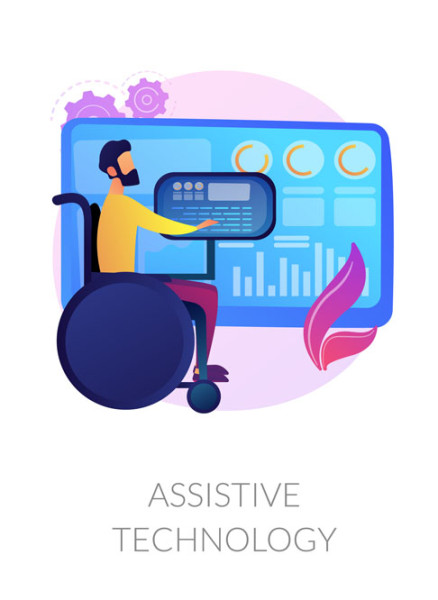
But, not all assistive technology that makes accessibility possible has to be cutting-edge high tech... Some solutions are simpler but also as effective. And they are available right here, right now. Did you know that even the humble computer keyboard is classed as assistive technology?
Users with a disability, impairment or access needs use assistive technology to help them read, navigate and interact with websites and other online content – like screen readers and other accessibility tools (like Bnode’s own Accessibility Tool for websites). But, assistive technology like a screen reader or accessibility tool alone isn’t a universal solution to accessibility. Your website must be built properly and with assistive technology in mind before users with accessibility needs can actually access them and the content on your web pages correctly.
That is, until such a time as everyone who is visually impaired has implants or uses Meta Specs.
Getting the professionals in to do a full audit gives you a more detailed breakdown of your website’s accessibility status and any issues, not just an overview.
Quick and easy automated testing is all well and good, but you can’t beat manual testing for a full and comprehensive audit.
Here at Bnode, we offer Accessibility Audits and deliver Accessibility Training too.
As the first step in making your existing website fully accessible, we will do a thorough audit and make recommendations for improvement and optimisation. Then, once you’ve got the audit results and a to-do list of changes to make, you can either take that away to implement yourself or in-house, or we will work with you to make the changes.
If we recommend that the best outcome for you is for us to design and build a completely new and fully accessible website - and you want to go ahead, of course - we’re the West Yorkshire-based specialists in accessible and inclusive web design and build. Get in touch to find out more.
 Tender Response Limited