Secure AI, Trusted Advice
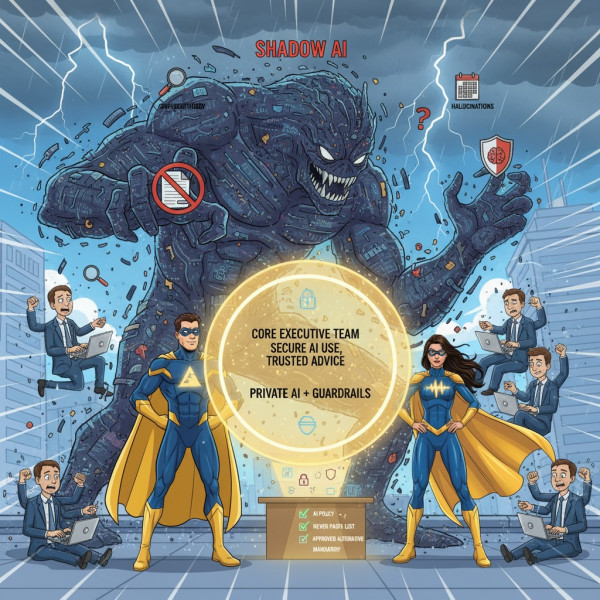
Shadow AI means employees use AI tools at work without approval, controls, or visibility. It’s happening now: staff paste emails into ChatGPT to “tidy them up”, summarise notes, rewrite contract clauses, draft advice, or generate client responses.
It feels harmless because it saves time-but once client data or regulated work touches an uncontrolled AI tool, you’ve created a risk you cannot audit, justify, or undo.
For UK regulated firms-solicitors, accountants, financial advisers-this isn’t a tech issue. It’s a professional duty issue.
The risks that bite hardest:
- Confidentiality and data leakage (GDPR + client trust)
Pasting client names, addresses, financials, legal documents, or case details into public AI tools means transferring personal data to third parties-often without lawful basis, contract, or assurance on storage or use. You remain fully accountable. - Hallucinations and confident errors
Generative AI can sound right but produce false or misleading content. In one recent legal case, submissions contained non-existent case citations generated by AI. One bad citation or paragraph can cause reputational damage or regulatory penalties. - No audit trail = no defence
Shadow AI usage leaves no records of inputs, outputs, or reliance. This is lethal during complaints, file reviews, disputes, or regulatory scrutiny. If you can’t evidence your AI use, you can’t defend your advice. - Reputational blast radius
Clients don’t forgive “we were experimenting with AI” when confidentiality is breached or advice quality falters. Trust lost is hard to regain.
Examples:
- Legal sector: A solicitor relied on AI-generated submissions with fake legal citations. This led to potential loss of privilege and court penalties.
- Accounting sector: A CPA uploaded confidential client data to an open AI model during an audit. Errors in the AI output surfaced during review, risking regulatory complaints and client trust.
Shadow AI Checklist
- Write a 1-page AI policy this week
Define approved tools, prohibited tools, permitted use-cases, and sign-off protocols. Keep it clear and accessible. - Create a “Never Paste” list (non-negotiable)
- Client names and identifiers
- Contracts and legal documents
- Financial statements
- Case notes and health data
- Passwords and authentication codes
Anything covered by confidentiality duties must never be pasted into non-approved AI.
- Provide an approved alternative (or shadow AI will win)
Staff use shadow AI because official tools feel slow. Give them a secure, sanctioned AI option with transparent rules. Core Executive Team from Amplifyy is a great option.
- Make verification mandatory on regulated work
AI can draft, but humans must verify: check citations, reconcile figures, review advice, and document sign-off.
The clean solution: Private AI, with protection built in.
This is why the Core Executive Team exists: a private AI executive department installed inside your business so your data never leaks and outputs come with built-in guardrails.
- Data never leaves your business
- Nothing you input trains external models; it only improves your own system
- All data is hosted safely in the UK and EU
Shadow AI is already in your firm. Your choice: let it run wild and hope for the best, or install control that makes you both faster and safer.
Contact us to find out how the Core Executive Team from Amplifyy removes your Shadow AI risk.
 National Communities Resource Centre