SME businesses are adopting AI fast.
Public tools like OpenAI’s ChatGPT, Anthropic’s Claude, Google’s Gemini, X’s Grok, and Meta’s Muse are being used to draft client emails, summarise documents, create proposals, and “sense-check” decisions.
That speed is real. So is the risk.
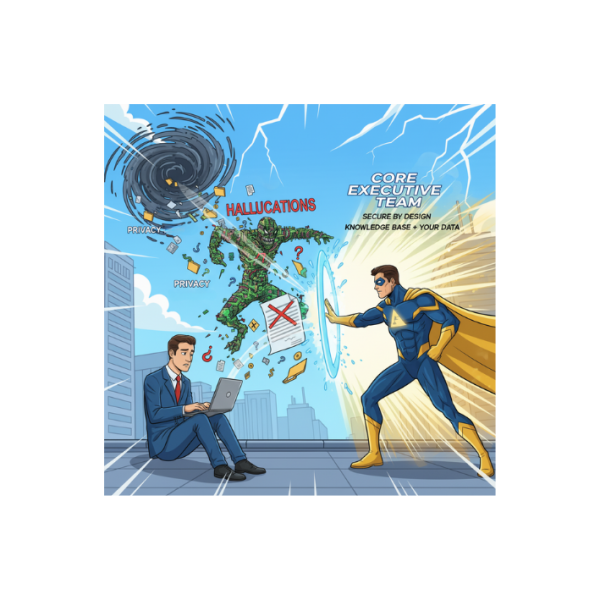
If your business is regulated (or simply reputation-dependent), two risks matter more than anything else:
- Privacy leakage
- Hallucinations (confident inaccuracies)
These aren’t abstract. They show up as breached confidentiality, wrong advice, incorrect compliance statements, or client-facing errors that damage your credibility.
In an owner-led firm, where the owner’s judgment drives direction, one bad output can become the wrong decision that costs you.
Privacy leakage (the silent liability you don’t see until it’s too late)
Public LLMs are external systems. The moment you paste information into them, you may have exported sensitive business data outside your governance controls.
In professional services, that “helpful paste” often includes:
- client names, personal data, and case details
- contractual terms, pricing, HR and staff issues
- draft reports or regulated communications.
Most teams do not do this maliciously. They do it because it’s quick.
But speed doesn’t change the underlying problem: you cannot treat a public model like an internal system.
You can’t reliably prove what was shared, you can’t easily audit it across the organisation, and you can’t confidently ringfence liability if it becomes part of a complaint, claim, or regulatory event.
The issue is governance: uncontrolled data leaving your environment.
Remember Public LLMs are public. The information you give them is out there and can be accessed by others.
Hallucinations (polished output that can still be wrong)
Public LLMs are excellent at producing language that sounds right. They are not designed to verify truth.
That’s why hallucinations are so dangerous: they look credible enough to survive a skim read-until they’re tested in the real world.
Short real-world example (legal hallucinated citations):
In Mata v. Avianca (US), lawyers submitted a court filing that contained 6 case citations that did not exist,. An AI tool made them up!
The lesson isn’t “lawyers were careless.” It’s that AI output can look authoritative and still be false. Public AI doesnt know the difference.
When your customers rely on you being right, hallucinations are brand damage.
You can use public AI for low-risk tasks. It can be better than nothing but you need to use a private system for anything sensitive or where you need to get it right and count on it.
It would be great if there were an AI that was secure by design, didn’t rely on random internet context for business-critical work, and reduced hallucinations by grounding answers in its own knowledge base of 8000 hours of business expertise and your own documents and knowledge.
Wait a minute…… That rings a bell.
 Amplifyy